
The Digital Product Pricing Paradox: Why It's So Hard
You’ve poured your energy into creating something valuable – an ebook, a template, a course, a digital art pack. It’s unique, it solves a problem, or it brings joy. Now comes the moment of truth: how much do you charge for it?
This isn't just a numbers game; it's a deep dive into psychology, market dynamics, and self-worth. Many beginners freeze here, caught between the fear of overpricing and scaring customers away, or underpricing and leaving significant money on the table. The digital product market is, yet countless creators struggle to monetize their efforts effectively because they view pricing as an afterthought rather than a core strategic lever.
The paradox is this: your product has no inherent physical cost, so its value is almost entirely perceived. This freedom can be paralyzing. Without manufacturing costs to anchor your decision, you’re left with questions like, "Is this worth $5 or $500?" The truth is, it could be either, depending on how you position it, who you sell it to, and the perceived transformation it offers. This guide will equip you with a concrete framework to navigate this challenge, ensuring your first digital product price is not just a number, but a smart business decision.
Before You Price: Understanding Your Product's True Value
Before you even think about a dollar figure, you need to understand the bedrock of your product’s worth. This isn’t about your time investment alone; it’s about the value it delivers to your customer.
Who is Your Ideal Customer, and What Problem Do You Solve?
This is the absolute first step. Who is this product for? What specific pain point does it alleviate, or what aspiration does it fulfill? A busy entrepreneur needs a time-saving template more than a student might. A struggling artist needs a guide to finding clients more than a hobbyist needs advanced techniques.
The more specific you are about your customer and their problem, the clearer your product’s value becomes.
- For the busy entrepreneur: Your "Ultimate Productivity Planner" isn't just a PDF; it's a promise of reclaiming 10 hours a week.
- For the aspiring freelancer: Your "Client Acquisition Blueprint" isn't just an ebook; it's a shortcut to financial independence.
- For the overwhelmed parent: Your "Meal Prep for Families" guide isn't just recipes; it's peace of mind and more family time.
The greater the pain point or aspiration your product addresses, the higher its perceived value, and thus, its potential price.
Cost-Plus vs. Value-Based Pricing: A Fundamental Choice
These are the two main philosophies for setting a price.
Cost-Plus Pricing (and why it's often a trap for digital products)
This method involves calculating your direct costs (time, software subscriptions, marketing spend) and then adding a markup percentage to ensure profitability.
Example:
- Your time spent: 20 hours at $50/hour = $1,000
- Software subscriptions: $50
- Marketing spend: $100
- Total "cost" = $1,150
- If you want a 100% markup, you'd aim for $2,300 total revenue. If you plan to sell 100 units, each unit would be $23.
The Trap: For digital products, your "cost" per unit is effectively zero after creation. Focusing solely on your time undervalues the impact of your creation. If your product saves someone 100 hours of work, is your 20 hours of creation still the only factor? Cost-plus pricing often leads to underpricing digital products because it doesn't account for the immense value leverage.
Value-Based Pricing (the smart choice)
This strategy sets prices based on the perceived value to the customer, rather than the cost of production. It asks: "What is this solution worth to my ideal customer?"
Example: If your "Ultimate Productivity Planner" helps an entrepreneur save 10 hours a week, and their time is worth $100/hour, that's $1,000 in saved value per week. A one-time purchase of $97 for a tool that delivers that kind of recurring benefit suddenly seems like a bargain.
The Power: Value-based pricing allows you to charge significantly more for products that deliver substantial transformation or savings. It requires a deep understanding of your customer's needs and the quantifiable benefits your product provides.
Don't just list features; articulate benefits. Instead of "Includes 50 editable templates," say "Saves you 20 hours of design work, letting you focus on client delivery." This shifts the perceived value dramatically.
What Are the Core Digital Product Pricing Strategies?
Once you understand your product's value, you can apply specific pricing strategies. Think of these as frameworks to position your product in the market.
- Market Penetration Pricing: Set an initially low price to attract a large customer base quickly and gain market share. This is effective for new products in competitive markets or for building an email list rapidly. The goal is to hook customers and then potentially raise prices later or upsell them to higher-value offerings.
- Price Skimming: Launch with a high price point to capture early adopters and those willing to pay a premium for innovation or exclusivity. Once that segment is saturated, gradually lower the price to appeal to more price-sensitive customers. This works well for truly unique or highly desirable digital products.
- Competitive Pricing: Set your price based on what competitors are charging for similar products. This requires thorough market research. You can price slightly above, below, or at par, depending on your product's unique selling propositions (USPs) and your brand positioning.
- Psychological Pricing: Leverage pricing tactics that appeal to human psychology. Examples include:
- Charm Pricing: Ending prices with .99 or .97 (e.g., $19.99 instead of $20) to make them seem significantly cheaper.
- Prestige Pricing: Setting a high price to convey quality, luxury, or exclusivity (e.g., $497 for a masterclass).
- Bundle Pricing: Offering multiple related products together for a single price, often at a discount compared to buying them individually. This increases perceived value.
How Do I Set My First Price Point?
This is where theory meets practice. Here's a step-by-step process for arriving at your initial price.
Step 1: Research Your Competitors (But Don't Just Copy)
Look at similar digital products on platforms like Etsy, Gumroad, Shopify stores, or even online course marketplaces.
- Identify Direct Competitors: Who is selling something very similar to yours?
- Analyze Their Pricing: What are their price ranges? Are they using tiered pricing?
- Understand Their Value Proposition: What do they offer? What are their reviews like? What are their strengths and weaknesses?
Action: Create a simple spreadsheet. List 3-5 competitors, their product, their price, and 2-3 key features/benefits. This gives you a baseline. For example, if competitors are selling similar templates for $15-$25, pricing yours at $5 or $150 will immediately stand out – either positively or negatively – and you need to justify that difference.
Step 2: Define Your Value Proposition Clearly
Based on your ideal customer and the problem you solve, articulate the core value.
- Quantifiable Benefits: Does it save time (how much?), money (how much?), or generate revenue (how much?)?
- Emotional Benefits: Does it reduce stress, increase confidence, or provide joy?
- Uniqueness: What makes your product different or better than alternatives?
This step helps you justify a higher price if your value is truly superior.
Step 3: Calculate Your "Floor Price" (The Absolute Minimum)
Even with value-based pricing, it’s smart to know your absolute minimum. This isn't your target price, but a safety net.
- Production Costs: Software, stock photos, fonts, virtual assistant help, design tools. Even if they are fixed, factor them in over your projected sales.
- Platform Fees: Every platform takes a cut.
- Etsy charges a listing fee ($0.20 USD) per item, a transaction fee (6.5% of the sale price), and a payment processing fee (typically 3% + $0.25).
- Gumroad's fees vary by earnings tier, starting at 10% + processing fees for new creators and decreasing to 2.9% + processing fees for high earners.
- Stripe charges 2.9% + $0.30 per successful card charge for online payments.
- Marketing & Advertising: If you plan to run ads, factor in a per-sale cost.
Knowing these costs helps ensure you don't inadvertently lose money, especially if your product sells at volume.
Step 4: Choose a Pricing Model (One-Time, Subscription, or Tiered)
The model you choose significantly impacts your revenue potential and customer perceived value.
| Pricing Model | Best For | Pros | Cons |
|---|---|---|---|
| One-Time Purchase | Ebooks, templates, standalone courses | Simple for buyer, clear value, immediate revenue | Requires constant new sales, limited recurring revenue |
| Subscription | Membership sites, recurring content, software | Predictable recurring revenue, customer loyalty, higher LTV | High churn risk, requires consistent value delivery |
| Tiered/Bundling | Software, comprehensive courses, services | Caters to different budgets, upsell opportunities, perceived value | Can be complex to manage, risk of overwhelming choices |
Step 5: Test and Iterate (Your First Price is a Hypothesis)
This is the most crucial step for beginners. Don't agonize over the "perfect" price. Pick a price based on your research and launch.
- Launch with a specific price.
- Monitor sales and feedback. Are people buying? Are they complaining about the price? Are they asking for more features that would justify a higher price?
- Consider A/B testing. If your platform allows, test two different price points simultaneously to see which converts better.
- Adjust.Don't be afraid to raise or lower your price based on data.
Start slightly higher than you think, especially if your product offers significant value. It's often easier to offer a discount later than to raise a price without strong justification.
The Pricing Model Playbook: One-Time, Subscription, or Tiered?
Each model has its place and suits different product types and business goals.
One-Time Purchase
This is the most common model for digital products. The customer pays once and gets permanent access.
- Ideal for: Ebooks, single templates (e.g., resume template, social media template pack), standalone mini-courses, digital art prints, stock photos.
- Pros: Simplicity for the buyer, immediate revenue, easy to understand.
- Cons: Requires continuous new sales, no recurring revenue stream, limited long-term customer engagement unless you have a strong upsell path.
Subscription Model
Customers pay a recurring fee (monthly, quarterly, annually) for ongoing access to content, tools, or community.
- Ideal for: Membership sites, software-as-a-service (SaaS) tools (like Notion templates with ongoing updates), stock asset libraries, exclusive content feeds.
- Pros: Predictable recurring revenue, fosters customer loyalty, higher customer lifetime value (LTV), encourages continuous content creation.
- Cons: High churn risk if value isn't consistently delivered, requires ongoing commitment to updates and support, customers expect continuous benefits.
Tiered/Bundled Pricing
Offer multiple versions of your product at different price points, or group several products together.
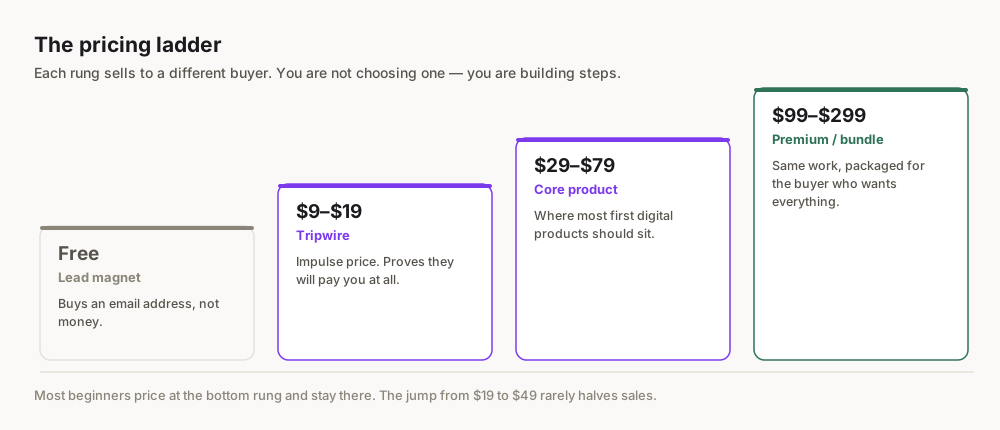
- Ideal for: Comprehensive courses (basic, pro, VIP tiers), software with varying features, template bundles, service packages.
- Pros: Caters to different budgets and needs, allows for upsell opportunities, increases perceived value through comparison (the "decoy effect").
- Cons: Can be complex to set up and manage, too many choices can overwhelm customers, requires clear differentiation between tiers.
Example of Tiered Pricing for a Course:
- Basic ($97): Core course modules, downloadable workbook.
- Pro ($197): Basic + private community access, bonus templates.
- VIP ($497): Pro + 1-on-1 coaching session, lifetime updates.
Should You Ever Offer Your Digital Product For Free?
Yes, but strategically. Giving away your product for free isn't always about charity; it's often a powerful marketing tool.
- Lead Magnet: Offer a valuable piece of content (e.g., a mini-ebook, a single template, a checklist) for free in exchange for an email address. This builds your audience, establishes trust, and provides a warm lead for your paid products.
- Freemium Model: Offer a basic version of your product for free, with advanced features or full access requiring a paid upgrade. This is common with software or interactive templates.
- Loss Leader: Price a product very low, or even free, to attract customers who will then purchase higher-priced items. For example, a free guide that promotes a paid course.
- Building Authority/Brand: In highly competitive niches, offering genuinely valuable free content can position you as an expert, leading to paid opportunities down the line.
The key is that free offerings should always have a clear purpose that supports your overall business goals. They shouldn't just be random acts of generosity.
Optimizing Your Price: Testing, Iterating, and Scaling
Your initial price is a starting point, not a finish line. The most successful digital product creators constantly monitor and optimize their pricing.
A/B Testing Your Price Points
If your platform allows, set up experiments where different segments of your audience see different prices. This is the most direct way to understand price elasticity. Even if direct A/B testing isn't possible, you can still test by:
- Running a temporary sale: See if a lower price significantly boosts sales volume.
- Raising the price for a new launch: Observe the conversion rate.
- Testing different bundles: Offer your product with varying bonuses at different price points.
Gathering Customer Feedback
Direct feedback is invaluable.
- Surveys: Ask customers why they bought (or didn't buy) and what they think about your pricing.
- Reviews & Comments: Pay attention to mentions of price in public reviews.
- Direct Conversations: If you have a community or direct communication channels, ask open-ended questions.
Sometimes, customers aren't complaining about the price itself, but about a perceived lack of value at that price. This might mean you need to enhance the product, or simply communicate its benefits more clearly.
The Power of Raising Your Prices (Confidently)
Many creators are scared to raise prices, fearing customer backlash. However, if your product consistently delivers value, receives positive feedback, and you've added new features or support, a price increase is often justified and necessary for sustainable growth.
When to consider raising prices:
- Increased Value: You've added new content, features, or improved the product significantly.
- High Demand: Your product is selling very well, indicating strong market acceptance.
- Positive Feedback: Customers are consistently praising the value they receive.
- Inflation/Cost Increases: Your own costs (software, marketing) have increased.
How to raise prices:
- Communicate transparently: Inform existing customers before the price change, ideally offering them a chance to purchase at the old price.
- Justify the increase: Explain why the price is going up (e.g., "to reflect new features and ongoing improvements").
- Focus on new customers: The new price applies to new purchases, not typically existing ones (unless it's a subscription model).
Legal & Platform Fees: Don't Get Blindsided
Understanding the various fees involved in selling digital products is critical for accurate pricing and profit calculation. Many beginners only consider the listed price, forgetting the cuts taken by platforms and payment processors.
Platform Transaction Fees
Most marketplaces and e-commerce platforms charge a percentage of each sale, sometimes in addition to a flat listing fee.
- Etsy: As mentioned, Etsy charges a 6.5% transaction fee on the sale price, plus a $0.20 listing fee per item.
- Gumroad: Their fee structure is tiered, starting at 10% for new creators and decreasing as you earn more. This includes payment processing.
- Creative Market: Takes 40% of the sale price for products sold through their platform.
- Other Platforms (e.g., Teachable, Thinkific for courses): Often have free tiers with higher transaction fees (e.g., 10% on Teachable's free plan) or paid plans with lower/no transaction fees.
Always check the specific platform's most current fee structure before listing your product. These percentages can significantly impact your net profit.
Payment Processing Fees
Even if you sell directly from your own website (e.g., using Shopify or WordPress with WooCommerce), you'll incur payment processing fees from services like Stripe or PayPal.
- Stripe: Typically charges 2.9% + $0.30 per successful card transaction in the US. International cards may incur additional fees.
- PayPal: Similar fees, often around 2.9% + $0.30 for standard online payments.
These fees are usually deducted automatically from the payment before it reaches your account.
Tax Implications
While not a "fee" in the traditional sense, sales taxes (like VAT in Europe or state sales tax in the US) can apply to digital products. This is a complex area, and it's essential to understand your obligations based on your location and the location of your customers.
Use a simple spreadsheet to calculate your net profit per sale. List your sale price, subtract platform fees, payment processing fees, and any marketing costs. This clear view helps you understand your actual take-home earnings and adjust your price accordingly.
Frequently Asked Questions
How do I know if my price is too high or too low?
If your product isn't selling at all, your price might be too high relative to its perceived value or market alternatives. If it's selling rapidly but with low profit margins, or if customers express surprise at how affordable it is, your price might be too low. The sweet spot is when sales are consistent, and customers feel they've received excellent value for their money.
Should I offer discounts or run sales?
Yes, strategically. Discounts can create urgency, attract new customers, clear older inventory, or reward loyal customers. However, frequent, deep discounts can devalue your product in the long run. Use them sparingly for specific promotions (e.g., launch discount, holiday sale) rather than as a permanent pricing strategy.
What if my product is unique and has no direct competitors?
This is a great position to be in! For truly unique products, focus heavily on value-based pricing. What problem does it solve that no one else does? What is the quantifiable benefit to the customer? You might start with a higher price (price skimming) to capture early adopters and then adjust based on demand and feedback. Emphasize the unique transformation your product offers.
How often should I review my pricing?
Aim to review your pricing at least quarterly, or after any significant product updates or market shifts. Don't be afraid to make adjustments. The digital landscape evolves quickly, and your pricing strategy should be agile enough to adapt. Consistent monitoring and iteration are key to sustained profitability.
Is it better to have a higher price and fewer sales, or a lower price and more sales?
It depends on your business goals and product type. A higher price with fewer sales might be ideal for high-value, niche products where customer acquisition cost is high, or for maintaining a premium brand image. A lower price with more sales works for mass-market products, building an audience, or leveraging upsells. Calculate your total revenue and profit for both scenarios to see which strategy aligns best with your objectives.