
The digital product market is booming, but with opportunity comes competition. Every day, thousands of new ebooks, templates, courses, and software tools flood marketplaces. In this crowded landscape, your product description isn't just text; it's your most critical salesperson, working 24/7 to convince potential buyers that your intangible offering is exactly what they need.
The stark reality? Most digital product descriptions are frankly terrible. They list features, use generic language, and fail to connect with the buyer's underlying desires. The result? Products languish unsold, despite their inherent value. This isn't about having a bad product; it's about failing to communicate its value effectively. I've seen firsthand how a well-crafted description can transform a struggling listing into a sales powerhouse.
This guide isn't just theory. It's a battle-tested framework for writing digital product descriptions that don't just inform, but genuinely sell. By the end, you'll have the tools to write descriptions that stand out, attract the right buyers, and convert browsers into loyal customers.
Why Your Digital Product Description Is Your Most Powerful Sales Tool
Imagine walking into a store where every product is hidden behind a curtain, and the only way to know what it is or why you need it is to read a short, compelling pitch. That's essentially the digital product landscape. Unlike physical goods, digital products lack tactile presence, visual weight, or the ability to be held and inspected. Their entire perceived value, utility, and desirability must be conveyed through words and supporting visuals.
Your product description isn't just a summary; it's a carefully constructed narrative designed to bridge the gap between your product's abstract nature and a buyer's concrete needs. It's the moment of truth where you convince someone to part with their hard-earned money for something they can't physically touch.
The Problem with Generic Descriptions
The biggest mistake I see beginners make is writing descriptions that sound like a technical manual or a bland list of specifications. Think about it:
- "This ebook has 5 chapters on productivity hacks."
- "My template includes 10 spreadsheet tabs."
- "This course has 2 hours of video content."
While accurate, these descriptions are transactional and uninspiring. They don't evoke emotion, solve a problem, or paint a picture of transformation. In a sea of similar offerings, a generic description ensures your product remains invisible, or worse, forgotten. It's a wasted opportunity to connect with your audience on a deeper level.
The Untapped Power of Persuasion
A truly effective digital product description acts as a highly persuasive sales agent. It anticipates questions, addresses objections, and, most importantly, articulates the transformation your product offers. It answers the fundamental buyer question: "What's in it for me?"
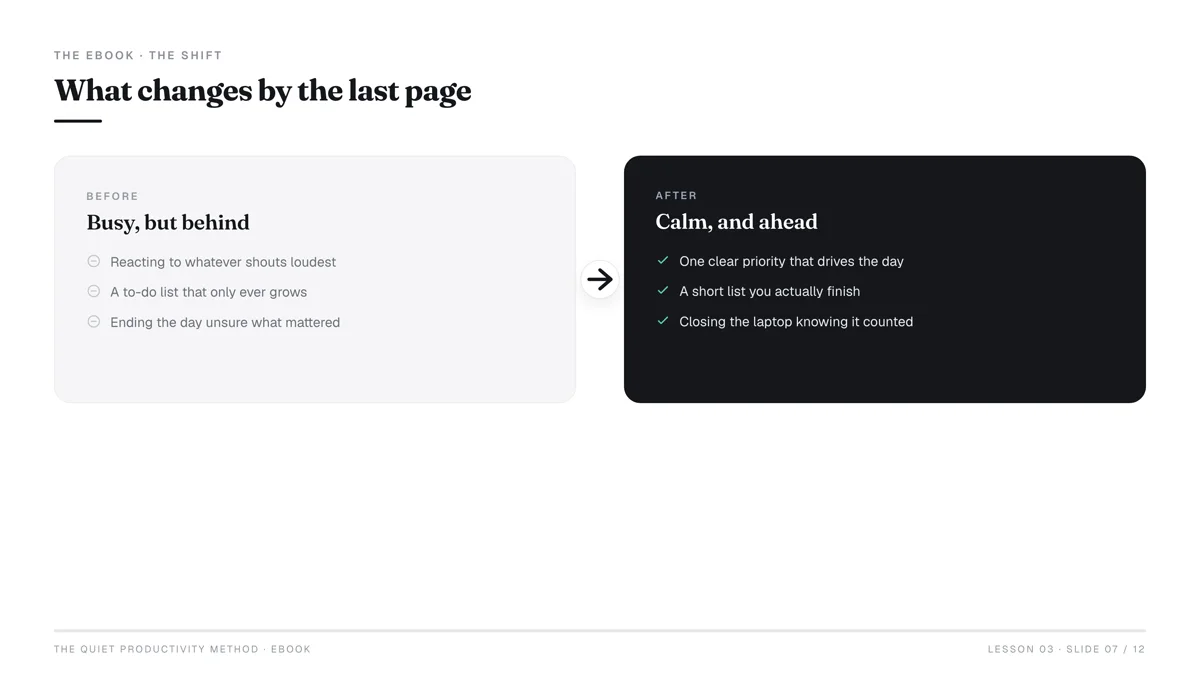
For example, instead of "5 chapters on productivity hacks," imagine: "Tired of feeling overwhelmed? This ebook isn't just about hacks; it's your personal blueprint to reclaim 10+ hours a week, transforming your chaotic schedule into a calm, focused workflow." This shifts the focus from the what (chapters) to the why (reclaiming time, feeling calm, focused workflow). This is the power of persuasion, and it's what separates top sellers from the rest.
Understanding Your Buyer: The Foundation of a Great Description
Before you write a single word, you must understand who you're writing for. This isn't just a marketing cliché; it's the bedrock of effective sales copy. Without a clear picture of your ideal buyer, your description will be a shot in the dark, hoping to hit something.
Who Are You Selling To? (Buyer Personas)
Develop a detailed buyer persona. Give them a name, a job, hobbies, and, most importantly, identify their pain points and aspirations.
- For a digital planner: Is your buyer a busy parent trying to juggle kids and work? A student needing to organize assignments? An entrepreneur managing multiple projects? Each persona has different motivations and will respond to different language.
- For an ebook on freelance writing: Is your buyer a complete novice looking for their first client? An experienced writer wanting to scale their income? A niche writer seeking specific strategies?
Understanding these nuances allows you to tailor your language, examples, and benefits directly to their specific context.
What Problem Are You Solving? (Needs & Desires)
Every digital product, at its core, solves a problem or fulfills a desire.
- Problem: Disorganization, lack of knowledge, inefficiency, creative block, financial stress, poor health.
- Desire: More time, better skills, increased income, creative expression, peace of mind, improved health.
Your description's primary job is to explicitly state the problem your buyer is facing and then position your product as the ideal solution. Don't assume they'll connect the dots. Spell it out.
The "Jobs To Be Done" Framework
Harvard Business School professor Clayton Christensen introduced the "Jobs To Be Done" (JTBD) framework, which posits that customers "hire" products to do specific "jobs" in their lives. People don't buy a drill because they want a drill; they buy it because they want a hole.
- For a budgeting spreadsheet template: The job isn't "create a spreadsheet." It's "gain control of my finances," "reduce financial stress," or "save for a down payment."
- For a Notion template for content creators: The job isn't "use Notion." It's "streamline my content workflow," "never miss a deadline," or "produce higher quality content consistently."
When writing your description, focus on the "job" your product is hired to do. This perspective shifts your copy from product-centric to customer-centric, which is far more persuasive.
Conduct mini-interviews with your target audience or browse forums/social media groups where they hang out. What questions do they ask? What frustrations do they express? Use their exact language in your descriptions. This builds instant rapport.
The Anatomy of a High-Converting Digital Product Description
A powerful product description isn't a stream of consciousness; it's a structured piece of persuasive writing. Here's a breakdown of the essential components:
1. Crafting an Irresistible Headline/Title
Your description often starts with a sub-headline or the product title itself on a marketplace. This is your first chance to grab attention.
- Focus on the primary benefit or transformation.
- Use strong action verbs and emotional language.
- Incorporate keywords for SEO (more on this later).
Bad: "Ebook: How to Start a Blog"
Better: "Launch Your Profitable Blog in 30 Days: The Ultimate Beginner's Blueprint"
2. The Opening Hook: Grab Attention Immediately
The first 1-2 sentences are critical. This is where you connect with the buyer's pain point or desire.
- Ask a provocative question: "Are you tired of your content ideas getting lost in scattered notes and forgotten drafts?"
- Present a relatable problem: "You've got amazing digital products, but your sales aren't reflecting their true value."
- Offer a compelling promise: "Unlock a consistent stream of passive income with our done-for-you printable templates."
Avoid generic intros like "Welcome to my product description..." Get straight to the point and make them feel understood.
3. Benefits Over Features: Speak to Desires
This is the golden rule of selling. Features are what your product is; benefits are what it does for the customer. People buy benefits.
- Feature: "Includes 12 customizable Canva templates."
- Benefit: "Save hours of design time and create stunning social media graphics in minutes, even if you've never used Canva before."
List your features, but for each one, ask "So what?" The answer is the benefit. Use bullet points to make benefits scannable.
4. Features: The "What" That Supports the "Why"
While benefits drive the initial interest, features provide the tangible proof and details. Once a buyer is intrigued by the benefits, they'll want to know the specifics.
- List them clearly and concisely.
- Use bullet points or a numbered list for readability.
- Example for a digital planner:
- PDF format, optimized for Goodnotes & Notability
- Hyperlinked tabs for easy navigation
- Daily, weekly, monthly, and yearly planning pages
- Goal-setting worksheets and habit trackers
- Printable version included
5. Social Proof and Trust Signals
In the digital realm, trust is paramount. Buyers want reassurance that your product delivers.
- Testimonials/Reviews: "See why over 500 creators rated this template 5 stars!" (If you have them, otherwise, this is for future iteration).
- Success Stories (generic): "Used by entrepreneurs worldwide to streamline their workflow."
- Guarantees: "100% Satisfaction Guarantee."
- Credibility: "Developed by a certified [expert field] with 10+ years experience." (If true, and only if it doesn't sound like invented personal stories).
If you don't have direct testimonials yet, focus on quantity sold (e.g., "Join 1,000+ happy users!") or mention the problem your product prevents (e.g., "Avoid the common mistakes new freelancers make").
6. The Clear Call to Action (CTA)
Tell your buyers exactly what to do next. Don't assume they know.
- Use strong action verbs: "Get Instant Access," "Download Now," "Start Your Journey," "Enroll Today."
- Create urgency (if appropriate): "Limited-time offer," "Don't miss out."
- Reiterate the key benefit: "Click 'Add to Cart' and transform your productivity today!"
7. Addressing Objections (Mini-FAQ within description)
Anticipate common buyer concerns and address them proactively within your description or in a dedicated "What You'll Get" or "FAQ" section.
- "Is this compatible with [software]?"
- "Do I need special skills to use this?"
- "What if I'm not satisfied?"
Proactive objection handling builds trust and reduces buyer friction.
SEO for Digital Product Descriptions: Get Found by Buyers
Even the most persuasive description is useless if no one sees it. Search Engine Optimization (SEO) ensures your digital product ranks high in marketplace searches (Etsy, Gumroad, Shopify) and even on Google.
Keyword Research for Digital Products
Think like your customer. What would they type into a search bar to find a solution like yours?
- Brainstorm seed keywords: Start with broad terms (e.g., "ebook," "template," "course," "digital planner").
- Use marketplace search bars: Type your seed keyword and see what autocomplete suggestions appear. These are real searches.
- Explore competitor listings: What keywords are they using in their titles and descriptions?
- Leverage tools:
- Google Trends: See keyword popularity and related queries [trends.google.com].
- Etsy Rank/Marmalead: For Etsy-specific keyword research.
- Amazon search suggestions: For ebooks or printables.
- Keyword research tools: Ahrefs, SEMrush, Ubersuggest (even free versions offer insights).
Focus on keywords with decent search volume but not overwhelming competition. Look for long-tail keywords (3+ words) which are more specific and often convert better. For example, instead of just "planner," use "digital budget planner for entrepreneurs."
Strategic Keyword Placement
Don't just stuff keywords. Integrate them naturally where they make sense.
- Product Title/Headline: Absolutely crucial. Place your primary keyword here.
- Opening Paragraph: Weave in your main keywords and secondary keywords naturally.
- Feature/Benefit Bullet Points: Sprinkle relevant keywords throughout.
- Tags/Categories: Most marketplaces have dedicated sections for keywords/tags. Use them all.
- File Names: If applicable, name your downloadable files with relevant keywords (e.g., "digital-budget-planner-2026.pdf").
Long-Tail Keywords: Niche Gold
Long-tail keywords might have lower individual search volume, but they often indicate higher purchase intent and face less competition.
- "Printable wedding planner for rustic themes" vs. "wedding planner"
- "Canva template for real estate social media" vs. "Canva templates"
Targeting these specific phrases will bring more qualified buyers to your listing.
Optimizing for Different Marketplaces
Each platform has its own quirks for SEO:
- Etsy: Strong emphasis on product titles, tags (13 allowed), and attributes. The first few lines of your description are visible in search results. Learn more about Etsy SEO.
- Gumroad: Descriptions are plain text, but good use of keywords in the title and the main body helps with Google search. Gumroad also relies on its discover feature, so clear categorization is key. Check Gumroad's best practices.
- Shopify: You have full control over SEO meta titles, descriptions, and URL slugs. Focus on blog content to drive traffic to your products. Shopify's comprehensive SEO guide.
Crafting Compelling Copy: Techniques That Convert
Beyond structure and SEO, the art of persuasive writing itself is paramount.
Storytelling: Weaving a Narrative
Humans are wired for stories. Instead of just stating facts, tell a mini-story about your ideal customer's journey from problem to solution.
- "Imagine waking up... [problem]. But what if you could... [solution]?"
- "Meet Sarah, a busy freelancer struggling to manage her client projects..."
- This approach makes your product relatable and helps the buyer envision themselves using it.
Using Power Words and Emotional Triggers
Certain words evoke stronger emotions and drive action.
- Urgency: Instant, now, quickly, limited, exclusive.
- Scarcity: Only, rare, unique, secret.
- Benefit-driven: Transform, unlock, master, boost, simplify, effortless, proven, guaranteed.
- Emotional: Freedom, peace of mind, confidence, joy, success, relief.
Sprinkle these strategically, but don't overdo it. Authenticity is key.
Clarity and Conciseness
Digital buyers have short attention spans. Get to the point.
- Eliminate jargon: Use language your audience understands.
- Cut unnecessary words: Every word should earn its place.
- Focus on one core message: What's the single most important thing you want them to know?
Formatting for Readability (Bullet points, bolding, whitespace)
Even the best copy will fail if it's a giant block of text.
- Short Paragraphs: Break up text into 1-3 sentence paragraphs.
- Headings & Subheadings: Guide the reader's eye and break content into digestible chunks.
- Bullet Points & Numbered Lists: Excellent for features, benefits, and steps.
- Bolding & Italics: Emphasize key phrases or benefits.
- Whitespace: Give your text room to breathe.
The AIDA Formula in Action
A classic marketing framework that still works wonders:
- Attention: Hook the reader with a compelling headline/opening statement (problem/desire).
- Interest: Deepen their engagement by elaborating on the problem and hinting at the solution (benefits).
- Desire: Make them want your product by showcasing its unique value and how it will transform their life (features + benefits, social proof).
- Action: Tell them exactly what to do next (CTA).
A/B Testing & Iteration: Continual Improvement
Your first description won't be perfect. The most successful digital product sellers are constantly testing and refining their copy. This isn't a one-and-done task; it's an ongoing process.
Why You Must A/B Test
A/B testing (also known as split testing) involves creating two versions of your description (A and B) and showing them to different segments of your audience to see which performs better (e.g., higher conversion rate). Even small tweaks can lead to significant increases in sales. Without testing, you're guessing.
What to Test (Headlines, Hooks, CTAs, Benefits)
- Headlines/Titles: The most impactful element. Test different benefit-driven headlines.
- Opening Hooks: Does a question work better than a statement?
- Call to Action: "Buy Now" vs. "Get Instant Access" vs. "Start Your Journey."
- Benefit Ordering: Which benefits resonate most strongly when listed first?
- Description Length: Is a shorter, punchier description more effective, or does a longer, more detailed one convert better for your product?
- Pricing (indirectly): While not part of the description, testing different price points often requires adjusting how your description communicates value.
Interpreting Your Results
Focus on conversion rate (sales per view/click). A 1% increase in conversion can double your revenue over time. Ensure your tests run long enough to gather statistically significant data, and only test one variable at a time to isolate the impact.
Tools for A/B Testing
- Shopify Apps: Many apps integrate A/B testing directly into your store.
- Google Optimize (now part of Google Analytics 4): Free tool for website A/B testing.
- Manual Tracking: For marketplaces like Etsy or Gumroad, you might need to manually rotate descriptions and track sales data over time. This is less scientific but still provides insights.
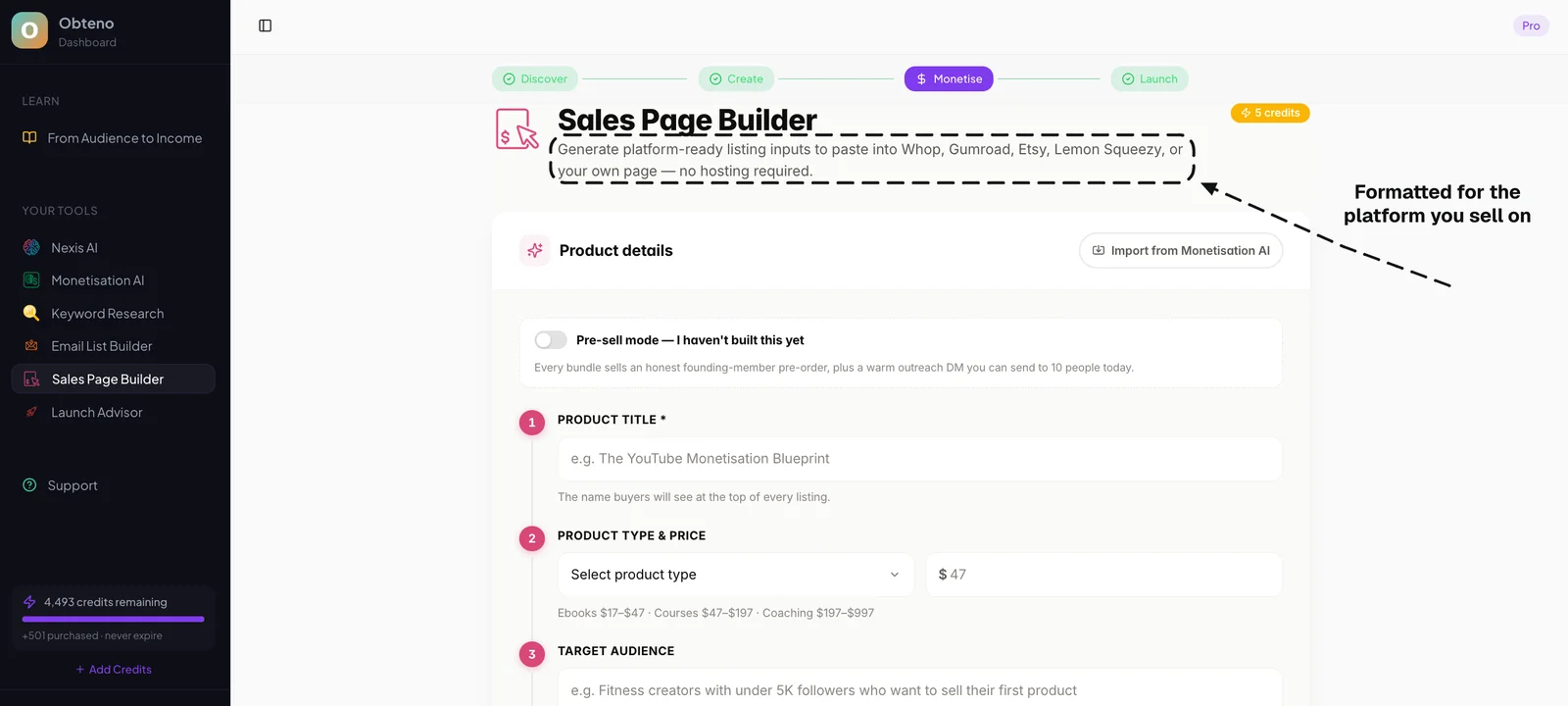
- Obteno: Obteno builds the product and writes the first version of the description, which leaves you testing wording rather than writing it from nothing.
Choosing the Right Platform for Your Digital Products: A Quick Guide
The platform you choose impacts how your product description is presented, discovered, and optimized. Here's a brief comparison:
| Feature | Etsy (Marketplace) | Gumroad (Creator-Focused) | Shopify (E-commerce Store) |
|---|---|---|---|
| Ideal For | Printables, digital art, templates, planners, mockups. | Ebooks, courses, software, music, memberships, templates. | Any digital product, especially if you have a brand/ecosystem. |
| Audience | Built-in, actively searching for specific items. | Self-generated, or via Gumroad Discover (small fee). | Self-generated, requires marketing effort. |
| Fees | Listing fee ($0.20) + 6.5% transaction fee + payment processing. Etsy Fees | 10% on products under $1000 lifetime sales, 7% above. Gumroad Pricing | Monthly subscription ($29+) + transaction fees (0-2% based on plan). Shopify Pricing |
| Customization | Limited to listing fields and shop banner. | Product page highly customizable with rich text & images. | Full control over storefront design and product pages. |
| SEO Control | Strong internal search, relies heavily on tags. | Good for external Google SEO with custom URLs. | Excellent, full control over meta descriptions & content. |
| Scalability | Can be competitive, difficult to build a brand. | Easy to scale, build audience, offer multiple products. | Highly scalable, ideal for large product catalogs & branding. |
| Ease of Use | Very easy to set up first listing. | Extremely simple to list products. | Steeper learning curve for full store setup. |
Your choice of platform should align with your product type, marketing strategy, and long-term goals. Each has its strengths, but regardless of where you sell, a powerful product description remains your most potent sales tool.
Frequently Asked Questions
What's the ideal length for a digital product description?
There's no single "ideal" length. For simpler products like a single template, 200-300 words might suffice. For complex products like a comprehensive course or software, 500-1000+ words are often necessary to cover all benefits and features. Focus on being thorough yet concise, ensuring every word adds value and answers potential buyer questions.
Should I include keywords in my description?
Absolutely, yes. Strategic keyword inclusion is vital for SEO, helping your product appear in relevant search results on marketplaces and Google. However, avoid "keyword stuffing," which can make your description unreadable and be penalized by search algorithms. Integrate keywords naturally within your compelling copy.
How often should I update my product descriptions?
It's good practice to review and update your descriptions periodically, at least once every 3-6 months, or whenever you notice a drop in conversion rates. You should also update them immediately if you add new features, get new testimonials, or receive feedback from customers that reveals common questions or objections. A/B testing can guide these updates.
Can I use emojis in my descriptions?
Yes, emojis can be very effective in digital product descriptions, especially on platforms like Etsy or social media. They can add visual appeal, break up text, highlight key points, and convey emotion, making your description more engaging and scannable. Use them judiciously to enhance, not distract from, your message.
What if my product is very similar to competitors'?
This is where your description becomes even more crucial. Focus on your unique selling proposition (USP). What makes your version different or better? Is it your unique perspective, a specific bonus, a particular design aesthetic, better customer support, or a specific niche you cater to? Highlight these differentiators prominently.
How important are visuals compared to the description?
Visuals (mockups, demo videos, screenshots) are incredibly important for digital products, as they provide the "visual proof" of an intangible item. They work in tandem with your description. Great visuals grab attention, but the description seals the deal by articulating value, addressing concerns, and guiding the buyer to purchase. Neither can fully succeed without the other.