
You've searched for ways to earn extra money. The internet offers two main paths: side hustles or digital products. Choosing the right one depends on your goals, time, and skills. This guide will help you understand the core differences and pinpoint which approach aligns best with what you want to achieve.
What is a Side Hustle?
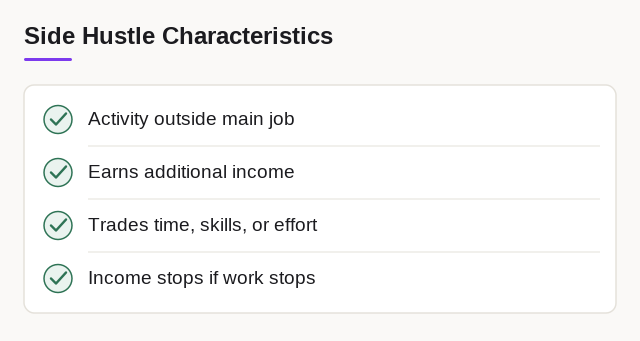
A side hustle is any activity you do outside your main job to earn additional income. You are typically trading your time, skills, or effort directly for money. This means if you stop working, the income stops.
Common Side Hustle Examples
Think of tasks that fill an immediate need for someone else.
- Freelance services: Writing, graphic design, web development, social media management. You complete a project, you get paid.
- Delivery services: Driving for food delivery apps or ride-sharing. You make a trip, you earn a fee.
- Tutoring or coaching: Teaching a language, a subject, or a skill. You spend an hour, you get paid for that hour.
- Pet sitting or dog walking: Caring for animals for a fee.
- Local services: Handyman work, cleaning, gardening.
These examples show a direct exchange. Your time is the primary commodity.
Advantages and Disadvantages of Side Hustles
Advantages:
- Immediate income: You can often start earning within days or weeks.
- Low startup costs: Many side hustles require minimal investment beyond your existing skills or tools.
- Direct client interaction: You build relationships and get immediate feedback.
- Flexibility: You often set your own hours and choose your projects.
Disadvantages:
- Time for money exchange: Your income is capped by the hours you can work.
- Limited scalability: You can only take on so many clients or tasks yourself.
- Active effort required: If you don't work, you don't earn.
- Client dependency: You need a steady stream of clients to maintain income.
When starting a side hustle, don't try to be everything to everyone. Pick one specific service you're good at and offer it to a very defined audience. A "copywriter for SaaS startups" will find clients faster than a "general writer."
Find a local business that needs a service you can provide. Offer to complete one small task for them at a reduced rate to build your first testimonial.
What is a Digital Product?
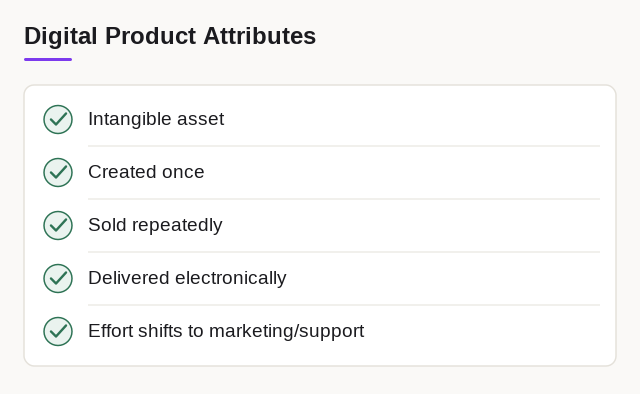
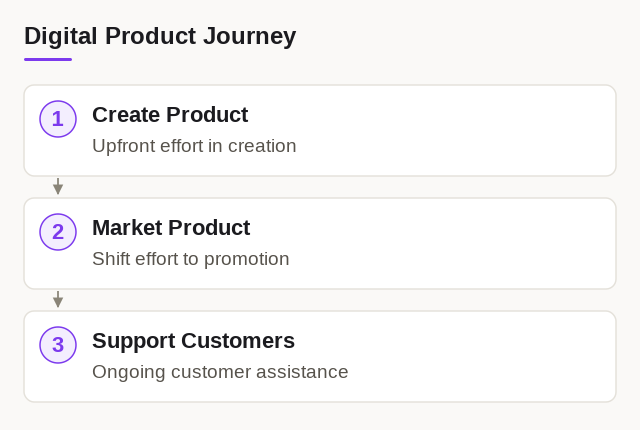
A digital product is an intangible asset that you create once and can sell repeatedly. It exists in a digital format and is delivered electronically. Once the product is made, your effort shifts from creation to marketing and customer support.
Common Digital Product Examples
These are items people download, stream, or access online.
- Ebooks and guides: Cookbooks, how-to manuals, business strategy guides.
- Templates: Notion templates, resume templates, social media post templates, budget spreadsheets.
- Online courses: Video lessons, audio lectures, written modules on a specific skill.
- Printables: Planners, journals, colouring pages, wall art.
- Stock photos, videos, or audio: Assets for other creators to use.
- Software or apps: Tools designed to solve a specific problem.
The key is that you create it once, and then you can sell it many times without needing to recreate it for each buyer.
Advantages and Disadvantages of Digital Products
Advantages:
- Scalability: You can sell to hundreds or thousands of people without significantly increasing your workload.
- Passive income potential: Once created and marketed, sales can occur while you're doing other things.
- Global reach: You can sell to anyone, anywhere, with an internet connection.
- Low variable costs: No inventory, shipping, or physical materials.
Disadvantages:
- Upfront effort: Creating a high-quality product takes significant time and skill before you earn anything.
- Marketing required: Products don't sell themselves. You need to actively promote them.
- Competition: Many people create digital products, so standing out is crucial.
- Customer support: Even with digital products, buyers will have questions or issues.
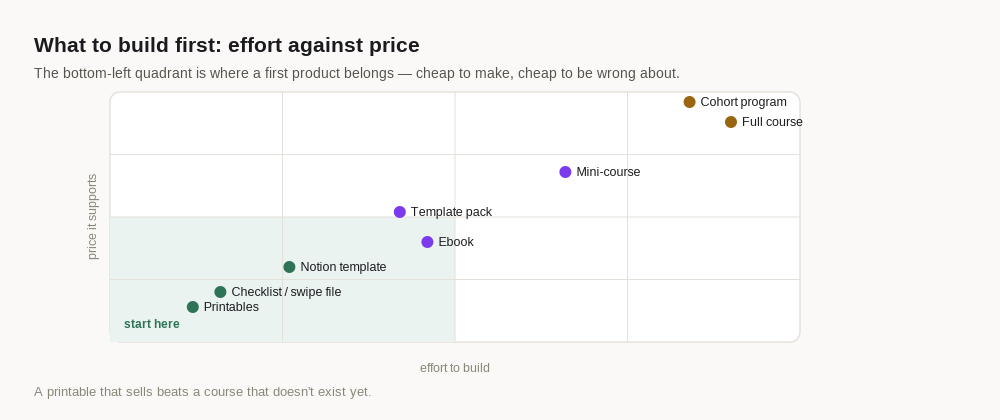
Your first digital product doesn't need to be perfect. Aim for "done" over "perfect." You can always update and improve it based on early customer feedback.
Identify a small problem you can solve for others. Create a simple, focused digital product that addresses just that one problem.
Side Hustle vs. Digital Product: The Core Differences
The choice between a side hustle and a digital product comes down to fundamental differences in how they operate and what they demand from you. Understanding these distinctions helps you align with your personal situation and long-term goals.
Time Commitment
A side hustle typically requires a direct, ongoing time commitment. If you're a freelance writer, you spend hours writing. If you're a dog walker, you spend hours walking dogs. The income is directly tied to the time you put in. You often see immediate returns for that time.
Digital products demand a heavy upfront time investment. You spend weeks or months creating the product, designing it, and writing the sales copy. During this creation phase, you earn nothing. Once it's launched, your time commitment shifts to marketing, customer support, and occasional updates. Sales can then happen without your direct, active involvement at the moment of purchase.
Income Model
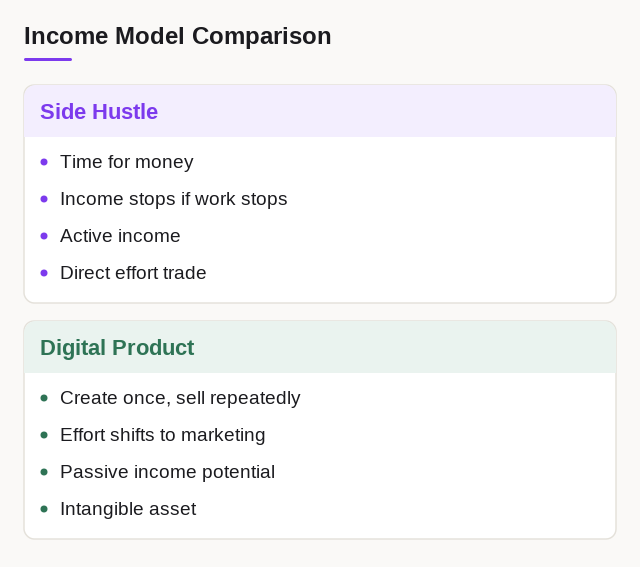
Side hustles operate on an active income model. You exchange your time or service for money. Your income ceiling is often limited by the hours you can realistically work. If you charge $50 an hour and can work 10 extra hours a week, your maximum extra income is $500.
Digital products offer a passive or semi-passive income model. You create the asset once, and it can generate revenue repeatedly. There is no inherent cap on how many copies you can sell. This means the income potential is theoretically much higher, but it's also less predictable, especially at the start.
Scalability
Scalability is where these two paths diverge most sharply.
A side hustle scales linearly, if at all. To earn more, you generally need to work more hours, charge higher rates (which limits your client pool), or hire others (which introduces management overhead). Your personal capacity is the bottleneck.
Digital products have high scalability. Once your ebook or template is created, selling 10 copies takes almost the same effort as selling 1,000 copies, primarily in marketing and distribution. The product itself doesn't need to be recreated. This is the core appeal for those seeking to build long-term wealth without trading all their time. However, this scalability isn't automatic; it still requires consistent marketing, audience building, and product refinement.
Core Differences Summary
Here's a quick comparison of the main characteristics:
| Feature | Side Hustle | Digital Product |
|---|---|---|
| Time Investment | Ongoing, direct exchange for income | Heavy upfront, then marketing/support |
| Income Model | Active income (time for money) | Passive/semi-passive income (asset for money) |
| Scalability | Limited by personal capacity | High, can sell to many without recreating |
| Startup Cost | Often low (existing skills/tools) | Can be low to moderate (software, specific tools) |
| Risk | Lower initial risk, but income is not stable | Higher initial risk (time invested with no guarantee) |
Consider what you need most right now. Do you need money in your bank account next week? Or can you afford to invest time now for a potentially larger, more flexible income stream in the future?
Think about your current financial situation. If you need money urgently, a side hustle might be the better immediate choice.
Which Path Suits You Best?
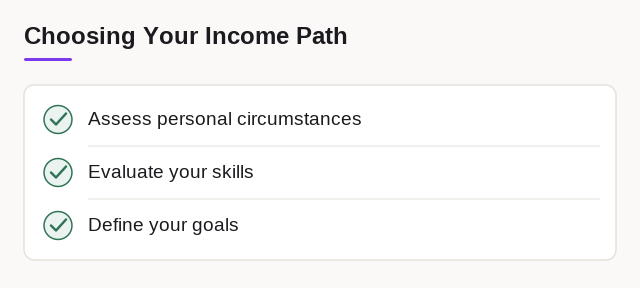
Your personal circumstances, skills, and goals are the deciding factors. There isn't a single "best" option; only the best option for you.
For Those Needing Immediate Income
If you need to supplement your income quickly, a side hustle is often the faster route. You can start offering services like freelance writing, virtual assistance, or local chores within days. Platforms like Upwork or Fiverr connect you with clients looking for immediate help. You trade your time and skills directly for money, meaning you see returns almost immediately after completing work.
This path is ideal if you have existing skills you can monetise without much preparation. If you're good at organising, you could offer virtual assistant services. If you're skilled with words, freelance writing is an option.
For Those Seeking Long-Term Growth and Flexibility
If your goal is to build an income stream that can grow beyond your direct hours, digital products offer that potential. The initial effort is high, but the reward is the ability to earn while you sleep, travel, or focus on other projects. This path requires patience and a willingness to learn marketing and sales.
It suits individuals who are creative, enjoy building things, and are comfortable with a delayed gratification model. You might spend three months creating an online course, but then sell it for years. This is about building an asset.
For Those With Specific Skills or Expertise
Consider what you're good at.
- If you excel at performing services: Are you a great photographer, a meticulous editor, or a skilled coder? A side hustle leveraging these direct service skills could be very profitable. You can charge premium rates for specialised expertise.
- If you have knowledge to share or a problem to solve creatively: Do you have a unique system for productivity? Can you teach a complex topic simply? Can you design beautiful templates? Digital products allow you to package this knowledge or creativity into a sellable format.
Your existing skills are your biggest asset, regardless of the path you choose. The question is how you prefer to package and deliver them.
Take five minutes to list your top three skills. Then, for each skill, brainstorm one side hustle idea and one digital product idea.
Getting Started with Digital Products
If you lean towards digital products, the journey involves several key stages. This is where the upfront effort pays off in the long run.
Finding Your Niche
Don't create a product for "everyone." Create it for "someone." A niche is a specific segment of a larger market.
- Identify a problem: What pain points do people have? What questions do they ask repeatedly?
- Consider your expertise: What do you know well? What are you passionate about?
- Look for demand: Use tools like Google Trends to see if people are searching for solutions related to your ideas. Search Reddit forums, Facebook groups, or YouTube comments to see what problems people discuss.
A good niche often sits at the intersection of your passion, your expertise, and market demand. If you're passionate about cooking and good at meal prepping, and people search for "quick healthy meal plans," you've found a strong niche.
Creating Your Product
Once you have your niche and product idea, it's time to build. This is the most time-intensive part.
- Outline your content: For an ebook, plan chapters. For a template, map out features. For a course, list modules and lessons.
- Use appropriate tools: For visual products like printables or templates, Canva is a popular choice for design. For writing ebooks, a simple word processor works.
- Focus on value: Your product must genuinely solve a problem or provide significant value to the buyer.
- If you're unsure where to start, tools exist to help. Obteno builds the ebook, designs the cover, and writes the sales copy for you. It produces the complete digital product files.
Pricing Your Product
Pricing is a balance. Too high, and you lose sales. Too low, and you undervalue your work and leave money on the table.
- Research competitors: See what similar products in your niche are selling for.
- Consider perceived value: How much is the solution to the buyer's problem worth to them?
- Start small: You can always increase your price later as you gather testimonials and improve your product. It's harder to lower it without upsetting early buyers.
- Offer tiers: Sometimes, a basic version at one price and a premium version with extras at a higher price works well.
Selling Your Product
You need a platform to host your product and process payments. Remember, Obteno produces the product files and listing copy; it is not a checkout or storefront. You sell the finished product on platforms like Gumroad or Etsy.
Here are some popular options for selling digital products:
- Gumroad: 10% + $0.50 per sale.
- Etsy: $0.20 per listing and 6.5% of the sale price, plus payment processing fees.
Work out what you would keep on a sale with our free Etsy fee calculator.
- Marketing: Promote your product where your target audience hangs out. This could be specific subreddits, Facebook groups, or niche communities.
- Build an email list: This is your direct line to potential customers.
- Collect testimonials: Social proof is powerful. Ask early buyers for reviews.
Your first digital product might not generate huge sales, but it will teach you the entire process. Each subsequent product becomes easier.
Common Mistakes to Avoid
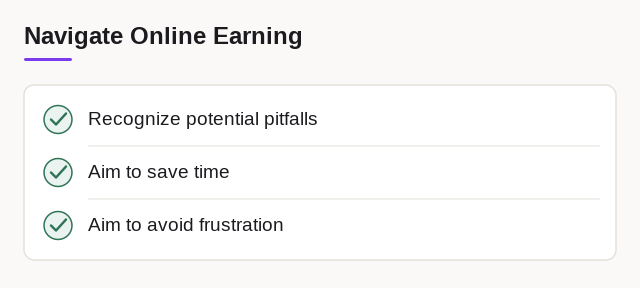
The path to earning online is filled with potential pitfalls. Knowing what to avoid can save you time and frustration.
Overthinking the First Step
Many beginners get stuck in the planning phase. They research endlessly, refine their idea repeatedly, and never actually launch. The perfect product or service doesn't exist at launch. It evolves.
A common mistake is waiting for absolute certainty. Certainty is rare. Action creates clarity. Your first attempt is a learning experience, not your final masterpiece.
Ignoring Market Feedback
You might think your product or service is brilliant, but if no one buys it, it's not. Pay attention to what your audience tells you, both directly and through their purchasing behaviour.
- Listen to complaints: They highlight areas for improvement.
- Observe what sells: If one type of product consistently outperforms another, lean into that.
- Ask for reviews: Positive reviews build trust, and constructive criticism helps you iterate.
Your product is for your buyers, not just for you.
Expecting Instant Results
Building a sustainable income stream, whether through side hustles or digital products, takes time. There's no magic button for overnight success.
- Side hustles: Building a client base takes networking and delivering consistent quality.
- Digital products: Creating the product, building an audience, and refining your marketing strategy is a marathon, not a sprint.
Success often looks like a series of small, consistent efforts compounding over months and years. It rarely looks like a sudden, massive windfall.
Your First Steps Today
You now have a clearer picture of side hustles and digital products. The next step is to move from understanding to action.
- Define your immediate need: Do you need cash within weeks, or are you building for the long term? This clarifies your primary direction.
- List your top 3-5 skills: What are you genuinely good at? What do people ask you for help with?
- Research demand for those skills: Use Google Trends to see if there's search interest for services or products related to your skills.
- Choose one small, actionable idea: Don't try to build a full course or launch a complex service. Pick one tiny project you can complete in a week.
- If you chose a side hustle: Open a freelance platform like Upwork or Fiverr and create a profile listing your chosen small service.
- If you chose a digital product: Outline the content for your first, simplest product. For example, a single-page printable or a 10-page guide.
Frequently Asked Questions
What is the difference between active and passive income?
Active income is money earned by directly trading your time or effort, like a salary or a freelance fee. Passive income is money earned with minimal ongoing effort after the initial work is done, such as sales from a digital product or rental income.
How much does it cost to start a digital product business?
Startup costs can vary widely. You might start with free tools and platforms, incurring only transaction fees on sales. For more advanced tools or marketing, you could spend hundreds of dollars. Obteno's pricing is $39, $69, or $99 per month after a 7-day free trial, providing a comprehensive product creation tool.
Can I do both a side hustle and create digital products?
Yes. You can run a side hustle for income now and build a digital product alongside it, using the skills and customer questions you pick up along the way.
How do I market my digital product?
Marketing involves reaching your target audience. This can include social media promotion, building an email list, running paid ads, guest blogging, or optimising your product listings on marketplaces like Etsy. Focus on where your ideal customer spends their time online.
What are the typical fees for selling digital products online?
Fees vary by platform. For example, Gumroad charges 10% + $0.50 per sale. Etsy charges $0.20 per listing and 6.5% of the sale price, plus payment processing fees. Always check the specific pricing page for any platform you consider.
Is it too late to start selling digital products in 2026?
No. What matters is making something useful, focusing on a specific niche, and adapting to what buyers ask for.